
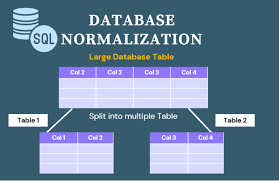
Database normalization is a process in relational database design that organizes data to reduce redundancy and improve data integrity. Proper normalization ensures that your database is efficient, consistent, and easier to maintain.
Why Normalize a Database?
- Eliminate Redundancy: Avoid storing the same data in multiple places.
- Improve Data Integrity: Reduce the chance of inconsistent or conflicting data.
- Simplify Maintenance: Updates, inserts, and deletes become more manageable.
- Optimize Queries: Well-structured tables improve performance in many cases.
Normal Forms (NF)
Normalization is done in steps called normal forms. Each normal form has specific rules:
- First Normal Form (1NF)
- Ensure that each column contains atomic values (no multiple values in a single column).
- Each row should be unique.
Example:
| StudentID | Name | Courses |
|---|---|---|
| 1 | Alice | Math, English |
1NF Conversion:
| StudentID | Name | Course |
|---|---|---|
| 1 | Alice | Math |
| 1 | Alice | English |
- Second Normal Form (2NF)
- Table must be in 1NF.
- All non-key columns must depend on the entire primary key, not just part of it.
- Solves partial dependency in composite keys.
Example:
| OrderID | ProductID | ProductName | Quantity |
|---|
ProductNamedepends only onProductID, not the whole key (OrderID + ProductID).
2NF Conversion:
- Split into two tables:
- Orders:
OrderID, ProductID, Quantity - Products:
ProductID, ProductName
- Orders:
- Third Normal Form (3NF)
- Table must be in 2NF.
- No transitive dependencies: non-key columns should not depend on other non-key columns.
Example:
| EmployeeID | Name | DeptID | DeptName |
|---|
DeptNamedepends onDeptID, notEmployeeID.
3NF Conversion:
- Employees:
EmployeeID, Name, DeptID - Departments:
DeptID, DeptName
Higher Normal Forms
- BCNF (Boyce-Codd Normal Form): A stricter version of 3NF.
- 4NF & 5NF: Handle multi-valued dependencies and join dependencies, used in complex databases.
Key Takeaways
- Normalization improves data consistency, maintainability, and reduces redundancy.
- Over-normalization can lead to excessive joins, which may affect performance; balance is key.
- Most applications are normalized up to 3NF or BCNF for optimal design.
Conclusion
Database normalization is a fundamental concept for designing efficient and reliable relational databases. By applying normal forms step by step, developers can ensure clean, structured, and consistent data, which is crucial for scalable and maintainable applications.